
 IT support isn’t just technology support; it’s business support. That’s because using IT as a strategic asset can differentiate your company and increase your profits. Be one of the few companies that really “gets” IT. Ask us how you can use it to gain an edge.
Differentiate your company and increase your profits—with IT
It’s easy to think of IT as a tool that comes with a cost—but doing so is a big mistake. That’s because IT, when used properly, can be a strategic asset. It can make your information more accurate, improve your employees’ response time, and even differentiate your company in the marketplace.
To make IT a strategic asset as opposed to a tool, it needs to add value. To determine where to make improvement, you’ll want to look at your value chain, which includes all the activities your business performs, and ask which ones earn profits. For example, if you’re a manufacturer, better IT could result in more efficient supply purchasing. If you’re a retailer, better IT could result in fewer units needing after-sales service and repair. Focus on improving IT in those areas and you’ll likely improve profits.
An added benefit of this exercise: The use of IT in a new way may create even more opportunities for your company. For example, the Internet allowed Apple to invent iTunes, and now mp3 downloads have overtaken CD sales. Even small businesses can experience this. Case in point: The invention of iTunes has given many startup software companies a distribution channel for apps that otherwise may not have been invented. But the idea doesn’t have to be visionary in this way: YourLittleFilm.com, a small business that creates custom short films, used customer relationship management (CRM) software to help follow up on business leads, and got a 10 percent response rate.
How and where you add value with IT developments will depend on your business model. There is little point, for example, in automating production if your customers cherish hand-made products. However, you might find that investing in a CRM system might give you a more efficient way to track your customers’ preferences and provide them with a more personalized service.
Using your IT as a strategic asset gives you tools to manage clients worldwide, increases your visibility, and lets you compete with much larger players. Contact us to find out how you can use technology to gain an edge.
 The ROI Series: Calculating the ROI of a Technology Investment—Part 1: Cost savings are always important to small businesses—but that doesn’t mean you should skimp on technology. New technology may be necessary for the survival and growth of your business, and may not be as expensive as you think when you consider its return on investment (ROI). In this four-part series, we’ll explain what ROI is, help you understand the types of ROI, and provide guidelines for predicting and measuring the ROI of a technology investment.
 It’s not uncommon nowadays to see both Macs and PCs together the same office. Technology has progressed to a point where both types of systems can now get along smoothly with each other. Its easy to share files between the two systems, share printers, have them communicate to each other on the same network, even run the same applications on both systems! Read on to find out how.
 Many IT service providers are learning valuable lessons from the Epsilon incident – which saw one of the world’s biggest email service providers become a victim of cyber-criminals, compromising a substantial amount of information entrusted to them by their clients.
 Google +1 is an experimental program by Google aimed at making searches much more effective and efficient. Through a nifty +1 icon that appears beside Google search results, users with a Google profile can recommend sites by simply clicking on the +1 button.
 While doing regular data backups is the norm in many businesses, many forget an integral factor in ensuring that the backup system works – actually testing it.
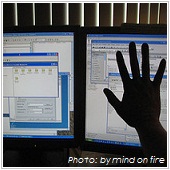 Studies have shown that dual or multiple screen monitors can help boost productivity significantly, enabling businesses to complete tasks and meet client concerns much more efficiently and speedily.
 Symantec recently released a study showing dire figures – at least 50% of SMBs out there have little to no disaster-preparedness plan, which if left unchecked can cost thousands of dollars in lost revenue.
 Employees have access to a wide variety of electronic information, from the moderately important (such as email lists) to the critical (such as financial records and trade secrets). Upon their departure, HR managers should work with IT to ensure that employee account access is blocked.
 When we create a letter in the analog world, we take the time to seal that letter in an envelope to keep it safe from prying eyes—especially if that letter contains sensitive information. If it’s highly confidential information we might even resort to obfuscation such as using coded text, or making sure that it is delivered via secure channels such as by special messenger.

